

Is this your first time buying an air purifier? If so, you must have plenty of questions boggling your mind.
For instance, a lot of first-timers ask, “How many air purifiers do I need?”
Some also wonder about the size that’s right for their home or if it’s wiser to buy a whole-house air purifying system than multiple units.
To make the right decision, we’re here to help you out.
We’ll cover the most important things to consider so that you can confidently shop for the right size and number of purifiers that match your needs.
How Is Air Purifier Capacity Calculated?
The general rule is that the bigger your house, the more air purifiers you need.
Unfortunately, there is not a single most reliable measurement to determine how many units you need.
That said, we will have to look into several things.
You will want to determine the size of your home, the capacity of the purifier, and the amount of indoor air that needs to be filtered.
Below is a detailed description of each factor so that you can decide for yourself.
Room Coverage
As you shop around for the best air purifiers, you will notice that their product descriptions include information about coverage.
This number refers to the capacity rating of the machine, which is given in square feet.
For example, the Austin Air purifier covers 266 square feet, which means it effectively cleans indoor air in rooms not exceeding this size.
Air Changes per Hour (ACH)
The room coverage does not cover all the information you need.
You also need to measure the amount of indoor air in your home and compare it to the ACH of the machine.
ACH determines how well an air purifier filters indoor air per hour.
As a rule of thumb, the higher the ACH, the better the purification outcome of the machine.
Most experts, including the American Society of Heating, Refrigerating, and Air-Conditioning Engineers (ASHRAE), recommend a minimum of 4ACH for the highest possible level of air purification.
Cubic Meter per Minute (CFM)
Another important number is the CFM value, which refers to how many cubic feet of air a purifier can scrub per minute.
Typically, a standard room air purifier has 250 CFM, meaning it can filter 250 cubic meters of air per minute.
To determine the number of purifiers you need, you have to convert the CFM to ACH.
To do that, just multiple 250 by 60, which gets you 15,000 cubic feet.
Indoor Air Volume
Lastly, you want to determine the amount of air that the purifier needs to clean.
You can calculate air volume by multiplying the floor area (width) with the ceiling height (length).
For example, if you have a 2,000 square-foot home with an eight-foot ceiling height, its total air volume is 16,000 cubic feet.
For the best results, you want your purifier to clean it about four times every hour.
That said, multiply 16,000 cubic feet by four, which is 64,000 cubic feet.
How Many Air Purifiers Do I Need?
To determine the number of air purifiers you need, use this formula:
No. of air purifiers = Amount of air to be cleaned / Air purifier airflow
No. of air purifiers = 64,000 / 15,000
No. of air purifiers = 4.2
Given the example, you need at least four standard room purifiers with an ACH of four.
You should consider using more room purifiers if you or someone in your household suffers from severe allergies or asthma.
Alternatively, you can purchase bigger units with higher ACH ratings and wider coverage.
How Big of a Purifier Do You Need?
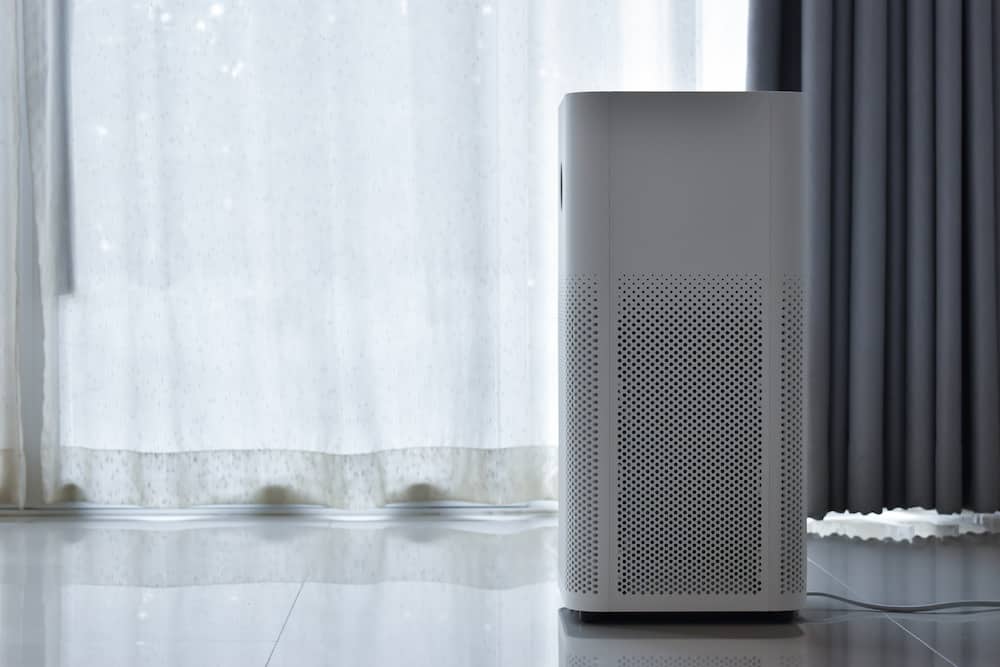
Now that you know how many air purifiers do I need, your next step is to determine the size of the unit you need.
To answer this, it pays to look at the so-called CADR rating of the machine.
It measures how many cubic feet of air a purifier can effectively remove each type of particulate.
Note that different particulates have varying CADR ratings, with the highest possible rating being 450 for smoke and pollen and 400 for dust.
Similar to the ACH, the higher the CADR score in a given category, the more efficient the machine is at removing particulates in that size range.
The Association of Home Appliance Manufacturers (AHAM) conducts CADR tests.
The problem is, keep in mind that not all units carry a CADR measurement, as this testing is voluntary.
Is a Single Whole-House Purifier Better Than Multiple Purifiers?
If you have a relatively big house, you have an option to opt for either a single built-in purifier or several portable units.
While whole-home air purifiers are a great solution to breathing easy at home, they require a more considerable initial investment.
Plus, they have to be professionally installed and integrated into your HVAC system, which means you have to shell out even more money.
In comparison, you don’t need professional help to install room air purifiers.
Just place them in a room, plug them in a wall socket, and they’re good to go.
For these reasons, most people prefer room air purifiers designed to filter the air in one or two rooms rather than the entire house.
These machines are typically programmable, with some specifically targeted at filtering out particulates that cause asthma, allergies, and other respiratory problems.
Also, some purifiers address specific situations, such as smoke, VOCs, and chemical sensitivity.
That means even if you have a whole-home purifier installed or not, it’s never a bad idea to get a portable unit.
Having one gives your home an extra burst of fresh air.
What Else Do You Need to Know?
Once you figure out how many purifiers you need, the next thing to consider is where to place each unit for the most efficiency.
You could have several bedrooms at home, plus other confined spaces, like a gaming area or a home entertainment center.
Ideally, you want an air purifier for each room.
You may also have two rooms connected by a wide doorway or opening, such as your living room and dining room.
In that case, you need one purifier capable of servicing both rooms.
To determine the size of the purifier you need, simply measure each room’s area and sum them up.
The most economical way is to limit the use of purifiers to only the rooms or areas where your family spends most of the time.
These areas include the bedrooms, living room, and your home office.
Conclusion
Learning how to determine the number of air purifiers according to the size of your home is your starting point for fresher, cleaner, and healthier indoor air.
Luckily, it only requires simple computations for your indoor air volume.
Then, you can look at the unit’s ACH and CFM to see whether they fit the bill.
Remember that the higher the ACH and CFM, the better purification you will get.
Lastly, determine where to place each unit around your house if you need more than one.
This way, you can maximize the air cleaning benefits of your purifiers.